
OUR PROJECTS
Malaria Elimination Interventions in Zimbabwe, Eswatini & Namibia
Precious Innovations Ubuntu Global Charitable Trust( PI Ubuntu) team has conducted extensive research on how organisational systems in malaria zones can more effectively manage transitions from malaria control to elimination.
The team has conducted extensive research on how organisational systems in malaria zones can more effectively manage transitions from malaria control to elimination. The research culminated in the development and publication of the Leadership & Engagement for Improved Accountability & Delivery of Services Framework (LEAD)
that combined Participatory Action Research (PAR) and Quality Improvement (QI) methods to tackle malaria. The tool has been implemented in Zimbabwe (2016-2020), Eswatini (2016-17) and Namibia (2019-2021), leading to significant improvements in elements of programme delivery, including data quality and communication, as well as fewer drug stockout events. These programme delivery improvements have subsequently led to improved detection, testing and treatment in regions that represent more than 3 million people exposed to risks of malaria in Zimbabwe alone. Additional benefits, such as capacity building of healthcare professionals and development of accredited training of National Malaria Control Programme staff, have also accrued, creating sustainable impacts in these regions. Findings and outcomes of these initiatives have been published in peer review journals (Marr Chung et al., 2020; Agnis et al., 2022; Marr Chung et al., 2022).
Applying Participatory Action Research and Quality Improvement Methods
Informed by findings and recommendations of Golsling et al. (2015), fieldwork conducted in the Central Highlands of Vietnam (2014-2016) by a member of the team, Participatory Action Research (PAR) and Quality Improvement (QI) methods proved effective in identifying, analysing, and resolving context-specific operational challenges in resource-poor environments. Through a series of workshops, healthcare staff and volunteers (from the most junior front-line staff to the most senior medics and administrators) were able to meet in the same space and communicate the challenges they faced when tackling malaria. Careful facilitation permitted junior staff to speak their minds and be heard by senior clinicians and administrators at district, provincial and national levels of the health care system. Employing PAR and QI techniques, post-workshop multi-disciplinary Task Forces were constituted, charged with collectively refining and implementing agreed solutions to challenges.
Subsequent work in southern Africa (2016-2020), supported by the BMGF-funded Malaria Elimination Initiative (MEI), enabled expansion of and development of a structured process intervention tool known as the Leadership & Engagement for Improved Accountability & Delivery of Services Framework (LEAD). Between 2016 and 2018, the LEAD intervention tool was trialled and up-scaled in three countries in southern Africa. In the 2016-17 malaria season, the tool was introduced in Eswatini and Matabeleland South province in Zimbabwe. The project expanded during the 2017-18 malaria season to Matabeleland North and Midlands provinces, making it operational in over half of Zimbabwe. The same LEAD intervention methodology was subsequently employed to address malaria elimination challenges in Northern Namibia (2019-2021). The approach is unique in malaria elimination: it involves all levels of the system (national, provincial, district, community); facilitates communication between these levels; allows the participants to identify the operational challenges they plan to tackle; and provides coaching and a structured process for co-designing interventions and facilitating and monitoring change.
Malaria Outcomes and Impact in Southern Africa
Significant populations in Zimbabwe benefit from improved malaria programme delivery
Better delivery of malaria programmes, underpinned by the implementation of the LEAD Framework resulted in improved malaria case detection, testing and treatment for 23% of the population of Zimbabwe (3.3 million people) between 2016 and 2018. The most significant quantitative improvements to malaria healthcare indicators were: (i) a 35% increase in case investigation rates within 3 days (from 65% to 100%) (Marr Chung, et al., 2020); (ii) an 11% increase in the treatment of confirmed cases with Artemisinin-based combination therapies (from 89% to 100%) (Marr Chung, et al. , 2020).
Footprint in Southern Africa
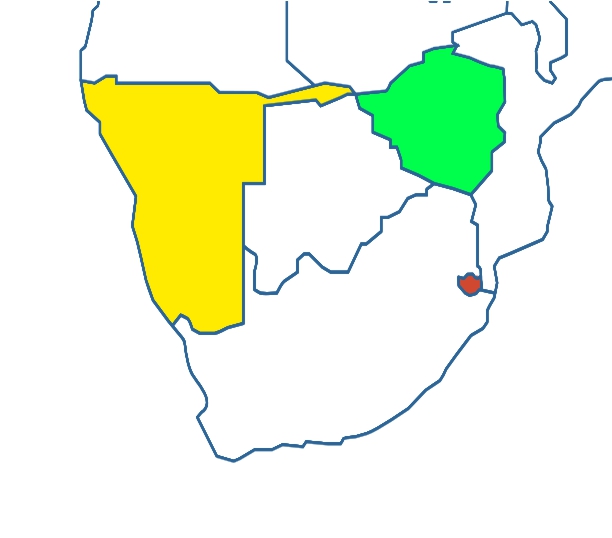
Projects in Southern Africa
Improvements in malaria programme delivery in Eswatini and Zimbabwe
Implementation of the LEAD Framework across Eswatini led to improvements in the reporting of malaria cases by health facilities and increased collaboration between the malaria programme, schools and community organisations (Marr Chung et al., 2020). It has also led to improved communication between leaders within the National Malaria Control Programmes (NMCP) in the form of better meeting structures and more efficient information flows. In Zimbabwe’s Matabeleland South province, the system of structured organisational development led to an improvement in the availability and use of malaria registers by health facilities and an increase in malaria case investigation rates within three days. There was also a 16% reduction in Artemisinin Combined Therapy [key antimalarial drug] stockouts (from 22% to 6%) (Marr Chung et al., 2020).
The interventions introduced in Matabeleland North led to: increased collaboration with partners involved in malaria activities; reductions in stockouts of drugs and diagnostics; and improvements in staff motivation and accountability. In Midlands: data quality, completeness, and timeliness improved; community engagement activities increased; improved communication, ownership, and teamwork (Marr Chung et al., 2020).
Programme staff benefit through participation, shifting culture to one of empowerment
Participants from all countries and provinces reported having a better appreciation of the value of communication, teamwork, planning, continuous monitoring of data and adjustment of work plans, as well as gaining skills in listening, communicating and facilitating discussions. Participation in the intervention changed the mindset of malaria programme staff. It increased ownership and accountability, empowering them to identify and solve problems, make decisions and act within their sphere of influence, finding efficiencies in the system that could not be found using the traditional top-down approach. This improved motivation and communication between different cadres of health workers (Marr Chung, et al., 2020, 2022; Agnis et al., 2022).
Staff in Zimbabwe, acting independently, secured their own external funding to apply the LEAD Framework to new regions in Zimbabwe during the 2018-19 malaria season, as well as using LEAD to address new issues. A direct impact from this intervention in Matobo district, for example, was a very large increase in usage of Long Lasting Insecticide Nets (which help prevent transmission) from 37% of 39,285 nets to 98%, brought about by involvement and training of community leaders. Other quantitative impacts included: 21% improvement to malaria case investigation rates and significant improvements to the stock status of a key medicines (e.g., availability of a key drug treatment for sever malaria – Atesunate – up by 68%).
Global health organisations adopt ODME tool, extending reach of impact in Africa and Asia
2019-20 saw LEAD-informed interventions applied in Namibia under the auspices of a BMGF-funded Improvement Collaborative for Malaria Elimination (ICME) project lead by members of LUFG. The ICME was initiated with the aim of advancing service delivery for malaria elimination across two districts: Rundu in Kavango East and Nankudu in Kavango West. Impacts deriving from this project (S6) during the 2019-20 malaria season included but were not limited to: (i) in-service training in case management and surveillance in the Nankudu district increased from a baseline of 89% to 99.8%; (ii) case reporting and complete reports from facilities improved from a baseline of 60% to 100% in Nankudu district and from 60% to 100% in Rundu district; (iii) cross border collaboration to reduce imported cases of malaria in Nankudu district: non-local cases shared with Angolan colleagues improved from a baseline of 49% to 100%, with subsequent tracing reaching a 79% level (Marr Chunge, et al., 2022).
Health professionals in Zimbabwe and Namibia benefit from enhanced understanding of Change Leadership through university accredited training programmes for malaria elimination
The team established a training programme for six recruits (senior medics and administrators) in Zimbabwe with accreditation via a Postgraduate Certificate in Professional Practice in Change Leadership (PPCL) awarded by Bristol Business School, the University of the West of England (UWE). The first cohort graduated in 2019 and graduates have applied the approach in other Zimbabwean provinces, districts and countries, leading to regional capacity building, skills development and the potential for sustainable LEAD impacts and up-scaling. Three graduates were subsequently also being employed in Namibia to facilitate workshops and develop LEAD Work Plans for two districts in Kavango province (2019-20). A cohort of 12 Namibian health professionals completed the UWE PPCL programme (2019-20) and demonstrated their ability to apply the LEAD framework to their own workplace challenges.
Research informs and influences global malaria eradication efforts
The team’s contribution to the field of malaria elimination has been significant and far-reaching. Published work by team members is acknowledged in The Lancet’s 2019 Commission Report: Malaria Eradication Within a Generation (Feachem, 2019). It concludes that: “Effective management and implementation of malaria programmes are the most important requirements of national and regional elimination and eventual global eradication (pp.12-13).”
References
Agins, B., Case, P., Chandramohan, D., Chen, I., Chikodzore, R., Chitapi, P., Chung, A.M., Gosling, R., Gosling, J., Gumbi, M., Ikeda, D., Madinga, M., Mnguni, P., Murungu, J., Smith Gueye, C., Tulloch, J. and Viljoen, G. (2022) Effective management of district-level malaria control and elimination: Implementing quality and participative process improvements. BMC Public Health, 2:140. https://doi.org/10.1186/s12889-021-12322-2.
Feachem, R., Chen, I., Akbari, O., et al. (2019) Malaria eradication within a generation: Ambitious, achievable and necessary. The Lancet, 394(10203: 1056-1112. https://www.thelancet.com/journals/lancet/article/PIIS0140-6736(19)31139-0/fulltext.
Gosling, J., Case, P., Tulloch, J., Chandramohan, D., Wegbreit, J., Newby, G., Smith Gueye, C., Koita, K., and Gosling, R. (2015) Effective program management: A cornerstone of malaria elimination. American Journal of Tropical Medicine & Hygiene, 93(1): 135-138. http://www.ajtmh.org/content/journals/10.4269/ajtmh.14-0255
Marr Chung, A., Case, P., Gosling, J., Gosling, R., Madinga, M., Chikodzore, R., Hove, M., Viljoen, G., Chitapi, P., Gumbi, M., Mnguni, P., Murungu, J., Dube, B., Dhilwayo, P., Mberikunashe, J. (2020) Scaling up malaria elimination management and leadership. Malaria Journal, 19 (185): 1-14. https://malariajournal.biomedcentral.com/articles/10.1186/s12936-020-03255-z.
Marr Chung, A., Love, E., Neidel, J., Mendai, I., Nairenge, S., van Wyk, L. A., …Gosling, R. (2022). Strengthening management, community engagement, and sustainability of the subnational response to accelerate malaria elimination in Namibia. American Journal of Tropical Medicine and Hygiene, 106(6), 1646-1652. https://doi.org/10.4269/ajtmh.21-1195.
Precious Innovations Ubuntu Global Charitable Trust( PI Ubuntu) research informs and influences global malaria eradication efforts
The Precious Innovations Ubuntu Global Charitable Trust( PI Ubuntu) team’s contribution to the field of malaria elimination has been significant and far-reaching. Published work by Precious Innovations Ubuntu Global Charitable Trust( PI Ubuntu) is acknowledged in The Lancet’s 2019 Commission Report: Malaria Eradication Within a Generation (Feachem, 2019). It concludes that: “Effective management and implementation of malaria programmes are the most important requirements of national and regional elimination and eventual global eradication (pp.12-13).”